Showing posts with label Victorian History. Show all posts

Tuesday, November 10, 2015

Victoria's Daughters review

Because most of my projects right now consist of Christmas gifts for the upcoming holidays, I really can't put up anything right in relation to said projects (Spoilers!). Instead I'm going to try and spend the month of November catching up on my backlog of reviews. We're starting with a book.

Queen Victoria's Daughters by Jerrold M. Packard was plucked from a used bookstore maybe 2-3 years ago and I finally read it over the summer. As the title states, the core material covers Queen Victoria's five daughters; Vicky (Victoria), Alice, Helena, Louise, and Beatrice. From the formative years of their parents' relatioship, to the final days of Princess Beatrice during WWII, the book touches upon each of the Queen's daughters and the unique lives each of them lived.
amazon.com
As the daughters of a monarch who ruled over a quarter of the earth's population during her reign, the princesses' lives were closely watched - and ruled - by not only their parents but by their subjects as well. Each had their own personality, passions and faults, that helped define who they were as adults. Along with their lives, their statuses as British princesses had a huge impact among the ruling houses of Europe as marriages were made, alliances were formed then broken, and wars later waged.

Friday, August 14, 2015

Hidden Killers of the Victorian/Edwardian Home review


As I work through some of the finishing touches of my bathing costume, I've been watching oodles of shows to pass the time. I found this via my recommended shows list from my watching history on Amazon Prime.


"The dawn of the 20th century ushered in an era of fresh inventions and innovations: Electricity, refrigeration and many other materials promised to make life easier and more convenient. But lack of understanding meant that they frequently led to death."

Monday, September 15, 2014

Short History of Can-can

As I've been working on my dresses, my interest has been piqued in where the original dance came from, so I've been doing a bit of research.
Modern can-can dancers via Pinterest
The can-can first appeared around the 1830s, originating from a form of the galop dance, which was actually danced by couples. The galop is a fast dance. Named after the gait of a horse, it is done in a fast 2/4 time. During the dance, couples would perform high kicks and gestures with their arms and legs. Because of this, couples were brought in close contact with each other - closer than what was deemed "acceptable" by Victorian standards - lending to its scandalous origins.
Originally, the dance was done by large numbers of men at dance halls. As performers of the dance became more skilled, the can-can graduated from being a dance performed by couples, to a participatory form of entertainment done in dance halls. It wasn't until the 1860s to 1870s however, that it became more popularized by women and was developed into a dance for a single chorus line.

Many of these women were middle-class courtesans and semi-professional entertainers during these early years. During the 1890s though, professionals emerged, such as Jane Avril and La Goulue, who were well paid for performances at particular venues. The most well-known of these venues is the Moulin Rouge.
Moulin Rouge 1900 via Wikipedia
Established in 1889, the Moulin Rouge is best known for being the birthplace of the modern can-can dance. The Moulin had many visitors, including the Prince of Wales (future King Edward VII) in 1890 and the artist Henri de Toulouse-Lautrec.

Toulouse-Lautrec was a frequent visitor to the Moulin, and created paintings and posters for the dance hall and of the dancers who worked there.
Moulin Rouge: La Goulue (1891)
Jane Avril Dancing (1892)
Much of what we know about the can-can, with it's highly choreographed dance steps and high kicks, was developed more recently. This highly stylized French version of the can-can lasts about ten minutes and involves the high kick or battement, the ronde de jambe (quick rotary movements of the lower leg with the knee raised and the skirt held up), the port d'armes (turning on one leg while grasping the other), the cartwheel, and the grand ecart (the flying or jump splits). The authentic quadrille-based can-can is very demanding in its moves and performers must have good stamina, rhythm, and balance.
The dancer La Goulue
Part of the can-can's erotic history (aside from Victorian couples standing WAY to close together) stems from the attire the women wore. The most popular costume of the can-can dancer was the wide, circular skirt with layers of frilled ruffles underneath. These ruffles were supposed to simulate the layers of petticoats usually seen underneath women's dresses and skirts of the time period. Underneath, the dancers would wear black stockings and shorter drawers.

The high kicks and dance steps would require the dancers to lift their skirts and then flashes of leg in the contrasting stockings could be seen underneath. Some of the dancers would even bend over and throw their skirts over their backs, presenting their bottom to the audience.
Image via Pinterest
*           *           *
This short history is conglomerated together through different Websites I read through while trying to find more info. I do not know how much is fact vs. fiction, but I hope this provides a little enlightenment on the subject.

Sunday, March 16, 2014

Secrets of... series review

I've been so busy with sewing that I've fallen horribly behind on my reviews. In addition, I kind of had to work my way through this series before I could actually write a review. The first video I remember watching sometime last year (before I even started this blog), and the most recent was only a couple weeks ago.

Each of the episodes are between 60-90 minutes long, but chock full of history and information. I'll try to highlight the main subject of each and the topics of interest they cover.


Secrets of the Manor House
This takes an in-depth look at the country manor houses of England's aristocracy around the turn of the century. Good for those who are interested in Victorian and Edwardian history, the American Buccaneers, or the TV shows Upstairs Downstairs and Downton Abbey.


Secrets of Highclere Castle
Following in the wake Downton Abbey is this episode which covers the history of Highclere Castle (the real-life estate that stands in for Downton) and its inhabitants. It covers the history of the castle's designs and changes, the lives and adventures of the owners (both prior and most recent), and of the people who help to maintain the property in the modern age. Recommended viewing for anyone loves Downton Abbey, or those who like manor house history.


Secrets of Chatsworth
In the same strain of English manor houses is this episode about Chatsworth. Home of the Devonshire family, this also covers the history of the property and its occupants, touching upon notable individuals such as Georgiana Devonshire (the Georgiana of The Duchess). Good for those with interests in Georgiana or manor houses.


Secrets of Althorp: The Spencers
This episode focuses on the Spencer family, which still resides at the estate. Charles, the 9th Earl, narrates most of the program and goes over its history and prior inhabitants. Most notable is his sister Diana, the late Princess of Wales. This episode is best for those with an interest in the Spencer family or manor houses.


Secrets of Henry VIII's Palace: Hampton Court
Another house, but an entirely different one. Jumping back further in time to the 1500s, this episode visits one of King Henry VIII's favorite residences which still retains much of its original architecture. Great for those with interests in Tudor History and the English Renaissance.


Secrets of the Tower of London
It's hard to cover the entire history of this famous location in one hour, but they do a good job of catching the highlights of its history, inhabitants, and operation. It even influenced how the modern day London Bridge was built! Will interest those who like London history and Tower history in general since it spans a multitude of years.


Secrets of Selfridges
So I watched this one before I had any idea what it was and still loved it. The subject of this is pretty self-explanatory - Selfridges department store in London - and goes over the history of the store and its owner. Good bonus material for anyone watching Mr. Selfridge or even The Paradise. I haven't seen Mr. Selfridge yet, but now I want to!


Secrets of Scotland Yard
I don't know much about this topic, so it was good to help add to my knowledge base and is included since it's part of the series. This focuses on Scotland Yard's history and some its more notorious cases including the assassination attempt on Queen Victoria and Jack the Ripper, as well as modern cases. Good for those with an interest in London history, police crime, and watchers of the series Whitechapel and Sherlock.


All cover images are from Amazon.com

Some of these have more focus than others on topics that are related to Victorian and Edwardian history, but each touches upon these periods (even if it is only briefly). While I don't know yet if this is an actual "series" verses stand alone documentary episodes, I believe they're still great watches for those with the above mentioned interests and to just learn a few more secrets about some of these already famous locations.

Overall review - 4 out of 5

Thursday, December 12, 2013

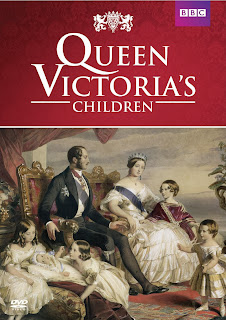
Queen Victoria's Children review

Looking back through posts, I realized that this is the first time I'm doing a review for a documentary film. This was a good film though and requires one.

For those of us who have busy schedules and a lot of books to read already (yes, me), sometimes we turn to documentary videos to do a little bit of catch-up on our knowledge. Queen Victoria's Children is a three-part series released by the BBC that chronicles Queen Victoria's relationship with her immediate family and the influence she had on them over the years.

http://www.amazon.com/Queen-Victorias-Children-Various/dp/B00BXTH44C/ref=sr_1_2?ie=UTF8&qid=1386869928&sr=8-2&keywords=Queen+Victoria%27s+Children
Amazon.com
Based on previous readings and film watchings, Victoria was a woman who never would have won any Mother of the Year awards. This documentary takes an objective approach to looking at her and Prince Albert's history and relationship, and the effects it had on how they raised their children. Both were very critical parents, and despite the outward appearance of domestic bliss in the royal household, there was an enormous amount of strife between the royal couple and their nine children.

A controlling and belittling critic of her children, Victoria at the same time drove her children away but also tried to keep them close enough to control their lives, even in adulthood. Pulling from historical events and personal papers and letters of the queen and her children, the filmmakers are able to bring to light a very detailed picture of Victoria as an occasionally doting, beastly overbearing, and appallingly narcissist mother.

From the arranged marriages she oversaw of most of her children, to the manipulative methods she used to try and keep them close, Victoria's portrayal of home-wrecker is less than ideal, but it's an aspect of her nature than helps to shed light on who she was as a queen and a mother.

Great in its use of historical fact and documents, the method of storytelling is also engaging and does not bore the viewer. Each of the episodes of well-defined in its focus point but also manages to tie into and lead to the next flawlessly. At about 3 hours, this short series is very informational and is a great view for anyone interested in Victorian history, but Queen Victoria herself.

Overall review - 5 out of 5

Tuesday, October 8, 2013

Dating like it's 1885

A couple months ago, I began dating for the first time. During a recent conversation, the subject of Victorian courtship was brought up. As I explained to Kerry, it's funny because I actually know the dating rule book from over 100 years ago, and it has changed quite a bit. How much? Well this is for Kerry, enjoy babe.


During the Victorian Era, the idea of dating was nonexistent. Instead couples went through a ritualized form of it known as "courting." Rather than being the romanticized ideal found in fiction, the courtship period was actually viewed more as a career move for a gentleman.

Courtship differed for each of the classes on both sides of the pond (America and England), due to different ideals and laws that were in place. For people growing up in rural areas, it was not as strict of an ordeal. Young couples could socialize with each other at events such as Sunday services, church gatherings, and community balls. Men were usually looking for a wife who would aid in helping to run the farm or the house, women for a husband who could financially support and take of them. These partnerships would have probably had a bit of mutual affection from both parties upon marriage.

Within the rigid structure and tradition of the upper classes though, courtship was very different. Matches were often made to aid in climbing the social ladder or to bring income into an impoverished estate or business. Rather than the church picnic, the way a young lady was introduced into Society was as a debutante at the start of the Season (England) or after she had finished her schooling (America), which was when she was about seventeen or eighteen. American society functioned on a year round social schedule. The London Season however, was the height of matchmaking for both American heiresses and English society girls. The Season ran from April through July and was an endless string of dinner parties and balls that the young woman attended in hopes of catching the eye of an acceptable suitor.

Acceptable meant a number of things. Usually a higher income was desired, the larger the better. Connections with business partners and the peerage were a plus. The holding of a title of any type was the ultimate catch.


The acceptable suitor was selected during the numerous social functions both men and women attended. Balls were the equivalent of speed dating that could lead to the courtship ritual. At these functions would be men and women of good standing and connections, in other words, acceptable marriage material. As previously mentioned, courtship was ritualized by strict rules. A certain amount of decorum was expected from these same men and women who were looking for a suitable partner for more than just the next quadrille.
  • Ladies must never enter or cross a hall unattended.
  • No gentleman is allowed to enter the ladies' dressing room at the ball.
  • Ladies should not dance with the same partner twice in a row, neither could they dance with the same gentleman for more than three dances.
  • Unmarried (and married) ladies could not leave the ballroom alone.
  • Gentlemen could never lead a lady into the ballroom by the hand, instead he offered his arm.
  • Gentlemen who were waltzing never pressed upon a lady's waist if he was not wearing gloves. If he had no gloves, he used a handkerchief.
This is just a handful of the etiquette rules found regarding balls. Because of it's rigidity, endless rules, and the interfering presence of chaperones, it could be hard to speak with anyone directly. The art of flirting using various accessories - fans, handkerchiefs, gloves, parasols - became a means of showing initial interest. Surprisingly, this silent communication was permitted because it was deemed acceptable.


Along with meeting, couples then had to be introduced properly, also requiring its own set of rules:
  • Unless being introduced by a mutual friend, a lady could not approach a person of higher rank. Before a lower-ranking person could be introduced, the higher-raking person also had to give permission.
  • Single women could not address men without first being introduced to them.


After the introduction and an initial conversation, the couple could look at possibly walking out together and keeping company. These were the initial stages of courtship, also dictated by another set of guidelines.
  • A lady could not receive a gentleman in her home while she was alone. Another family member had to be present.
  • No physical contact was allowed between the couple. The gentleman could offer his gloved hand if the road was rough, but this was it.
  • The lady could not be invited to visit the gentleman's place of residence.
  • Ladies could not ride in a closed carriage alone with a man, unless it was a close family member.
  • If a gentleman was visiting the lady's house, he could not stay late and did not visit at night.
  • Impure conversations were not held in front of single women.
  • Intelligence was not encouraged by the lady, neither was an interest in politics.
  • Meetings were supervised by a chaperone, typically an older female family member of the lady's family.

If the courtship progressed to the point of an engagement, the couple were then allowed to hold hands in public, go for walks unsupervised, and take unchaperoned rides. They were also allowed to meet behind closed doors, but had to be separated by nightfall.

While this method of dating may seem vastly outdated, it was in place for various reasons. The first was that a lady's highest asset was her virtue. These rules helped to ensure that it was never called into question. If there was even a whispering against the lady's character, it could forever tarnish her reputation. Courtship was also taken seriously because once it progressed to the point of an engagement, it usually resulted in marriage. Broken engagements were fodder for gossip and tarnished reputations.

*          *          *
For more fun info on Victorian etiquette and courting check out these books.


Friday, September 27, 2013

Queen Victoria's Gene book review

This book I chanced across while browsing through the history section at Half Price Books. While interested, I didn't buy it right away. Instead, used the old smartphone to snap a picture of the cover, went home and ordered it from the library instead.

It's been a while since I read a purely non-fiction piece of work and this one had me intrigued just from the title alone - Queen Victoria's Gene: Haemophilia and the Royal Family.
Amazon.com
For those who are not familiar with the history of Queen Victoria's family, they were carriers and recipients of the Hemophilia gene, a blood disorder that mostly affects males in the family by preventing blood from clotting properly. Two of Victoria's daughters, Alice and Beatrice, were carriers of the disease, and her son, Leopold, was affected by it. Through her children, it came to affect a number of the royal houses in Europe. What it strangely intriguing though, is the Hemophilia gene was never prevalent in the royal family until Queen Victoria's time.

The authors, D.M. Potts and W.T.W. Potts, set forward their research and ideas in the book about where this gene could have come from. Was it a 1 in 50,000 chance mutation, or was Victoria herself possibly the illegitimate offspring between the Duchess of Kent and a Hemophiliac man? The research is impeccable, and scientific proof helps to back up any of the theories they put forward.

The let down for me in reading this was based on the synopsis on the back cover, the authors were going to explore the possibilities of how history might have been different if the Hemophilia gene had not been prevalent in the royal families, specifically the Romanovs of Russia. In each of the history chapters though, they reiterate the historical facts, then relegate the alternative outcomes to only a few short paragraphs.

Exploration and investigation into other historical mysteries like the identity of Anna Anderson, the supposed lost Grand Duchess Anastasia, help to round out a the author's research on how Hemophilia could also help in identifying those who were related and what their roles could potentially mean.

The material itself isn't too dry, despite being rooted in historical and scientific facts mostly. It's the theories and the material that is put forward that drive book (excluding one chapter that just didn't make sense to me on why it was included). Although I know a number of things about Queen Victoria's family, there were still a few surprises (Kaiser Wilhelm and his wife are both great-grandchildren of the Duchess of Kent and therefore cousins), and definitely a few more questions to ponder.

Overall rating - 3.5 out of 5