Showing posts with label Undergarments. Show all posts

Tuesday, August 2, 2016

Young Girl's Crinoline Cage

Another year, another birthday, and another addition to Lexie's history wardrobe. Currently she has a calico dress, apron and bonnet, and some underthings. In the spirit of making a complete set of proper undergarments, I pulled Butterick B5901 back out to start working on the hoop skirt.
Butterick B5901
Everything went together well enough by following the directions. I made one alteration to the waistband - instead of fitted, it has a drawstring ribbon so that it is more adjustable. Easy enough to do with 1" grosgrain ribbon. I even got to do some stash busting as well.
This gathered trim came from a petticoat (My very first, horribly made one) that I tore apart a couple years ago. There just enough for the hem and it was a great way to re-purpose some materials that I had.

Tuesday, April 26, 2016

Regency Shift

Sooo...back in February I was looking for something to work on and while going through my fabrics, found some yardage of combed cotton lawn I had ordered during the fall. I had ordered it from Dharma Trading Co. with the intent of using it for some Edwardian underpinnings. Then I put together my Regency drop front dress.

While I do have a Regency shift already, I was the first one I made from cotton/poly broadcloth and the entire thing is machine sewn. As a result, it is very bulky, not breathable, and very stiff. The neckline is also cut very high and sometimes peeks out from my dresses. 

Originally I had used Sense & Sensibility's Regency Underthings Pattern, but I opted for the Laughing Moon Ladies' Regency and Romantic Era Corset, which includes pattern pieces for a shift.

LM #115
As I cut out pattern and fabric pieces, everything is pretty much the same in that there is a large front and back piece, shoulder piece, sleeve piece, and underarm gusset. I did some research into the LM pattern though and one of the things I noticed were a lot of people had issues with the back running a little high. To see how the shift would work out, I made a "half" mock-up of just the upper portion to check for for fit and any additional alterations that might be needed.

Just like the reviews, the back did run high. To help adjust this, I added 2" to the back of the shoulder strap pieces, and lowered the top edge the same amount to accommodate the change.

Saturday, January 2, 2016

Young Girl's Historical Underthings

Another post-holiday gift posting. In October, I started on a set of matched underthings for Lexie, the beau's younger sister. She had already received a dress and accessories, so I figured it was about time to outfit her with some proper underpinnings.

I did attempt to do some research for the project, but finding extant examples of undergarments for children is a hard thing to come by. The only things I found was this underdress from The Met.
http://www.metmuseum.org/collection/the-collection-online/search/100258?img=1
Petticoat 1838 - The Met
It matched the pattern I had in my stash from Butterick - B5901 Girl's drawers, underskirt, and hoop skirt. While the style matches, there is no particular date attached to the pattern, so it definitely makes it usable across a broad date spectrum.
Butterick B5901
After obtaining my measurements, I started work on the pattern according to the instructions. The drawers were super easy to put together and match many of the patterns I've put together for full scale women's drawers. They have the split crotch seam, waist ties, and pin tucks along the eyelet lace at the bottom of the pantalettes.

Monday, June 29, 2015

Regency Stays - Trial and Error Round One

Well I got my Regency stays finished to the point that I could try them on. So I did. And this is what I ended up with.

Wednesday, June 24, 2015

Regency Stay Cording

Waaay back in February, I began my foray into making some Regency corded stays. Then I was distracted by other projects. Now I'm back to working on the stays.

I got all my channels sewed finally and then started on the cording. Reading from the directions and recommendations within the sewing community, I got some cooking twine to use for the cording in the channels. Well the first time I went to thread a channel, I immediately discovered it was too big.

I double checked my directions, but didn't see any options outside of the cooking twine. Hmm. Then I remembered this thick cotton thread I had once used as a kid to try and crochet a head scarf. Possibility?
I found a 4 oz. package of Sugar'n Cream worsted cotton yarn at the local fabric store that matched what I remembered using. Took everything home and it ended up being just the right size!

Monday, February 16, 2015

Corded Regency Stays

So I've finally started my first sewing project of the year. Long ago I bought some fabric to make a new Regency dress. In order to get started on it though, I first had to make myself a new pair of stays. This is an endeavor I set out to do last spring, but never got around to starting at that time.
Future dress plans

As a reminder, I did make some half-stays, but wasn't wholly satisfied with the fit and design. I finally pulled out my Laughing Moon Regency and Romantic Era Corset pattern (#115) and started reading through the directions (there's a lot of material).

Wednesday, October 1, 2014

Red Cherry Blossom Corset

So in amongst my sewing for the wedding dress, I have still been slowly working my way through my own dress. One thing I decided to do was make a corset because:
a) my powder blue one looks odd with all the black and red 
b) what the hey, I'll take any excuse to make a new one

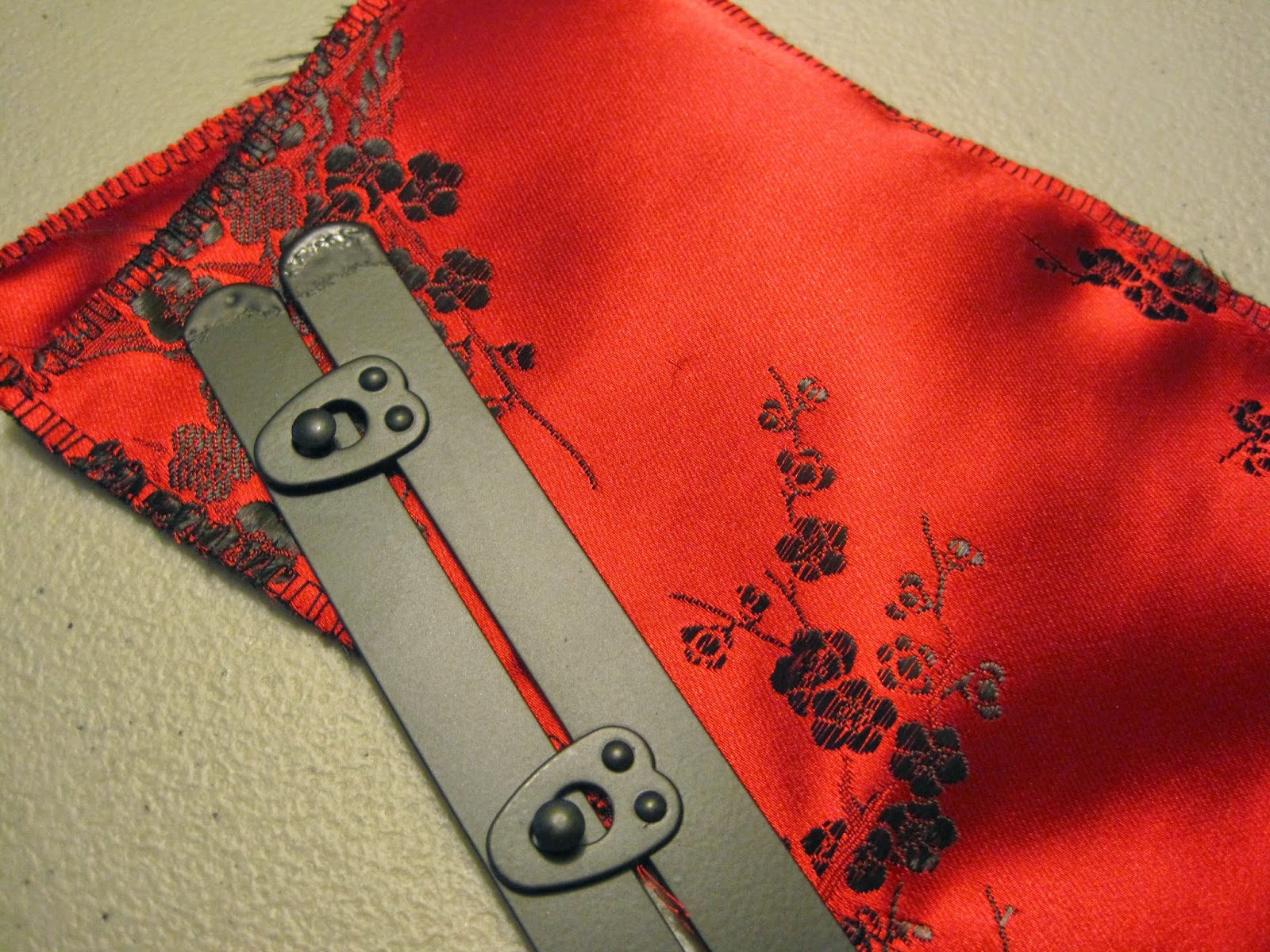
I got lucky and found a remnant piece of a cherry blossom brocade at Joann's that worked perfectly, and I had some black twill from a leftover project.
The fabric is more of a cherry red.
I pulled out my Truly Victorian (TV110) pattern pieces from my prior corset project and after rechecking measurements, made a secondary adjustment by letting out the hips one size. Once the adjustment was made, I recut the pieces and cut out the twill and brocade.
The next step was flat lining everything. A fun task since the brocade starts to fray as soon as it's cut and I ran out of thread during the process.
Along with thread, I had to order a new busk as well. Rather than use a standard busk with silver fastenings, I special ordered a black busk. When it came and I put it together with the material, I'm so glad I did.
I've had the last couple of days off from work, so I spent my time getting everything stitched together. Now I just having the boning channels, grommets, and binding to add and it will be finished!

Monday, May 26, 2014

HSF - Challenge #9 Black & White

Challenge - Black & White

Fabric - Poly/cotton broadcloth blend

Pattern - Truly Victorian Petticoats pattern (TV170)

Year - Natural Form period, about 1876-1882

Notions - Hooks and eyes for the waistband

Hours to complete - 14

First Worn - For waistband measurements. Will be wearing soon as I work on construction a Natural Form dress

Total Cost - $0, all materials were already in my stash and the pattern is one of my basics that I use frequently.


How historically accurate is it?
The pattern I use matches the silhouette needs of the Natural Form period with a slim front and some fullness towards the back. Everything is machine sewn however, so I don't know how accurate that would be in comparison to an original from that same time.

 
Yargh, I've really been slacking for my May posts. On the plus side though, I finished an item off the aforementioned project list. Double bonus, it works for one of the challenges! It's a few days late, but given my recent history with project issues, I'm not going to worry too much about being a little behind (still working on challenge #5 and #7).

The Natural Form period is one of the few areas of the Victorian Era that I don't have a dress from so I decided to make one up. Like many projects though, you have to start at the basics. In this case it was by making a petticoat. All the ones I currently have are fitted to go over hoop cages or bustles so there's a lot of extra material in them. The point of the Natural Form period is that things are very natural meaning there's very little modification to the silhouette outside of the corset.

Examples of Natural Form dress - Image via Pinterest
I dug out from my trusty TV170 pattern, which I use for most of my petticoats since it's a very universal, and managed to find the right amount of fabric in my stash then got to work.

It took a couple of nights to get everything pinned together and sewn because I like to pin and set my own ruffles rather than try to use a running stitch. The process can be very tedious at times, but the result is certainly worth it in my opinion because the ruffles are usually evenly balanced the entire length of the seam.

Hand pinned ruffles along lower tier

When going through the sewing machine, I just guide the fold in the direction I choose or press them flat.

Although Natural Form is known for some of the long, trained skirts with oodles of frills (see the above fashion plate for example), I opted to go with an untrained petticoat from the standpoint that it would be able to go under other costumes. Instead, for the trained skirts, I'll use a detachable balayeuse or dust ruffle. But that's another project for another time.

Sunday, May 18, 2014

Attacking the UFOs

The last time I had posted, I discussed the start of an overskirt for a ball gown that I have in the closet but have just never gotten around to finishing. I was all ready to get started on it, and then this funny little thing called life happened.

I had more setbacks with my long overdue bonnet project. Mother's Day popped up and I found myself wanting to make things for my awesome mumsy. I had project materials finally come in so I could finally finish a few things. Best of all, I get to go to my best friend's wedding in October! Her wedding theme is Alice in Wonderland, so I've been starting to put together costume ideas in my brain that could work and have been spending a lot of time looking at pictures from the recent Tim Burton film version.

Any who, that's another post for another day.

With all the UFOs (Un-Finished Projects) laying around, I decided to put aside my Black and White Challenge and make a list of the UFOs that needs to be tackled. 
  • Wedding samplers for friends
  • Regency Ophelia bonnet
  • Late bustle evening bodice
  • Black skirt from Vogue
  • Petticoat to go under a Natural Form (1877-1882) period dress
  • Calico Garibaldi blouse
Mind you, these are just the projects that are sitting out immediately in my living room. I'm sure there's more buried in my room.

Today was a good start to tackling this list. I finished my long overdue cross stitch piece, at least one of them.
Now to head off to the framer!

The petticoat should be fairly easy. I pulled out my favorite petticoat pattern from Truly Victorian (TV170) which covers almost the entire Victorian Era. With the exception of the bottom hem piece and the waistband, everything has been put together.
I'll be off in a couple more days so I should be able to get the last row ruffled and hemmed, and the waistband added.

Wednesday, February 5, 2014

New Challenges and Projects

As I wrap up my latest HSF project challenge, I already have to start looking forward to the next few projects. Although I'm only doing half of the challenges, challenge #4 - Under it All, aka any type of underwear/unmentionables, gave me some inspiration. I may not actually complete a piece for the challenge, but I'm going to use it as a jump point to start working on a pair of Regency stays.

Last spring, I made made a pair of half-stays to go under my first Regency dress. I had to do a lot of modification for my lack of cleavage as well as I didn't have a complete understanding of how Regency stays were supposed to fit (I'm used to my corsets). So the end result was a half-stay that worked/didn't work. 

Ignore the quality. Bad cell phone selfie.
The one thing I couldn't get used to when wearing the half-stays was not having my mid-section covered as well by the stay/corset. Naturally I'm not a very svelte individual to begin with, so the silhouette of the Regency dress I wore did not work out as well either.

Again, no time to actually finish a new Regency stay before the March 1 deadline. However I have started to pull together some images of originals on Pinterest for inspiration and I purchased Laughing Moon's Regency and Romantic Era Corset pattern.

Regency Corset via Pinterest
Early 19th Century Stays via Pinterest
Laughing Moon's Regency and Romantic Era Corset pattern
Challenge #5 - Bodice I already have something in mind for. My late bustle Alexandra Polka Dot dress was made a few years ago and it's probably one of my favorites.

The original bodice that I made is for daytime/dinner type of functions. To allow for more functionality, I've always wanted to make an evening bodice to go with the skirts (Also making it more period correct by having more than one bodice). I made an attempt at this about two years ago, but wasn't happy with how it turned out and scrapped it. I still have extra fashion fabrics and the pattern, so it's just a matter of sitting down to redraft some changes, then put everything together. We'll see how it goes!

Tuesday, January 21, 2014

1870s Bustle - Purple Madness!

Except for hooks and eyes on the waistband (I have to get more from the store) I am finished with my 1870s Grand Bustle finally!


Despite my fabric shortage issues, everything worked out well and now my grand bustle has become a bodacious purple bustle (cackles in laughter). Once it became apparent that I would have to incorporate a lighter shade of the purple into it, I went with it and had fun.

So not only is there alternating layers of ruffle, but the boning channels are also done in the lighter shade.


And I went ahead and grabbed some ribbon for the inner support panel in the same shade.


It's been a long process from start to finish but I'm very satisfied with the outcome of the project. Definitely looking forward to spring when I might be able to wear it with my Indienne tea dress or maybe I'll just have to start another early bustle dress to wear over it (mwu-ha-ha).


*          *          *


Fabric - Cotton broadcloth in two different shades

Notions - Grosgrain ribbon, grommets, metal boning, pre-made bias tape, x-large plastic zip-ties, hooks and eyes for closure.

Thursday, December 12, 2013

1870s Bustle Issues

Well I finally got my grommets in and sat down to attach them to the support panels of the bustle.


Then I started to piece together and attach the ruffles to the back of the bustle.


Only to find out that even though I did buy the required amount of fabric, there is not enough for the tiered ruffles that go along the back. I went off to the fabric store to try and pick up some more fabric (I only needed an additional yard) only to find they didn't have anymore of the bright purple fabric I'm using.

On to plan B. Since I have the lighter purple bias tape, I had visited the notion of alternating the strips of ruffle between dark and light purple but didn't want to go through the extra work (Yep, I was feeling lazy). Well now I get to go back to the drawing board and pull up that plan. 

I found a good coordinating fabric, so now I just have to sit down, cut strips, hem them, and then piece back together my dark purple strips of fabric so they fit in the area that I need them. In the end, I think the extra effort will give the bustle a really fun look.

Wednesday, October 2, 2013

1870s Bustle Start

In preparation for going to talk with the American Heritage Girls, I started to whip up a new bustle in case I had extra time to go over the 1870s period with girls (I always like to have extra things to talk about). Besides, it's been on the to-do list as part of the underfrillies overhaul.

I've definitely been in need of a new early bustle for awhile. My original bustle was made using the Truly Victorian Petticoat with Wire Bustle (TV101) and was done during that early "Before I Knew Better" sewing period. While it still looks fairly good -

It's definitely ready to be retired (or at least remade), considering this is how one of the interior bustle tapes is currently being held together.


As I've discovered, the early 1870s skirts need more support so I upgraded and purchased the Truly Victorian Grand Bustle (TV108) pattern. Rather than go with a simple white bustle again, I went through a few online museum collections and Web searches and found some inspiration in this early bustle from the Los Angeles Museum County Museum of Art.

Image via Pinterest
I'm a huge fan of the color purple as well so I found a nice cotton fabric in a semi-bright purple (because that's going to look great under those white petticoats). After cutting everything out, I started on my least favorite task - sewing and overlocking edges on ruffle, 7 yards of it.
I got a lot done actually in one afternoon, including adapting the inner support panel so that it laces and the bustle will collapse.

Marking the back pieces for the wire channels
Adapted panel pieces
Unfortunately, it was getting late and I ended up thwarted by the fact that I ran out of supplies. To finish, I have to get some more grommets but rather than order just grommets, I might as well take advantage of flat shipping and order some other corset and crinoline/bustle supplies that are on the shopping list as well.

Sunday, September 8, 2013

Corseting - Myth vs. Fact Pt. 2

A continuation of the previous post on corset myths and facts.

With these next myths, a number of the elements fell under previous headings, but the speculation behind them led me to place them in their own space. 
 
Image via Pinterest


Myth #5 - All women who wore corsets tight-laced them
Not true. While most women who could afford even a basic corset did wear one, not all women had the luxury or stamina to tight-lace. A working woman who had to rely on her mobility would not have chanced the restrictiveness of tight-lacing. An upper class or rich lady however, would have the means and ability to pursue tight-lacing if she chose.

Before we go into women who did tight-lace, we'll first cover what tight-lacing is exactly. The Victorian ideal for waist reduction was about 2"-4". Tight-lacing was even more extreme, reducing the waist by 4" or more. Rigorous training was involved with tight-lacing, usually beginning when the woman was a young girl. She would wear a corset that, over a gradual amount of time, would be reduced in size little by little. Take a look at Princess Mary of Teck's waistline. While it cannot be confirmed that she tight-laced, this was not something achieved overnight.

Image via Pinterest
When the desired waist size was achieved, it would be very hard to move around, breathing could only be done with small amounts of air since the lungs were compressed, and blood flow would be reduced to the internal organs.

Because of the extreme lengths at which the waist was reduced, it could result in health problems that were more extreme than some of the conditions mentioned in Myth #3. It also had a severe detrimental effect on the body...

(A small note on tight-lacing. I accidentally did it once while in a hurry to change into costume and forgot to measure my waist beforehand. I spend the entire morning feeling very light-headed, my ribs ached miserably, and even sitting caused pain. When I later checked, I had laced myself down to 31", I'm usually at about 33"-34".)

Myth #6 - Corsets deformed the natural body shape
Any time you alter the body in a way that it does not naturally occur, you are, in a way, deforming it. Even pierced ears are considered a way in which we alter our natural bodies. Corseting, especially tight-lacing, did the same exact thing.

Corsets molded and shaped the body to make the waist smaller. Worn on a daily basis as they were during the Victorian and Edwardian periods, the body would eventually start to retain some of the shape created by the corset. 


This illustration was used mostly by anti tight-lacing campaigners to show the effects a corset could have on a woman's body. Regular corseting may have compressed the ribcage and internal organs slightly, but not as much as tight-lacing did. Organs could end up in different locations altogether, and in some cases, the lower lungs would be compressed so badly that they would fill with mucus since the woman couldn't breathe in completely. The rib cage would be completely reshaped into a smaller form with the ribs angling more inward.

Before anyone starts to scoff and say how untrue it is, visit the Mutter Museum in Philadelphia sometime. They have on display two skeletons next to each other; one is a regular skeleton, the other is one that suffered the effects of tight-lacing. They look almost exactly like the illustration above. I would offer pictures as proof, but photography is not allowed in the museum.

The corset that was mostly responsible for the whole "deformation" issue is the Edwardian corset of the early 1900s. As fashion evolved at the turn of the century, so too did the corset that went underneath. Instead of a straight-backed hour glass figure, the awkwardly bent, S-bend became all the rage. This new figure still retained the reduced waist, but now the corset was designed to push the woman's lower backside back, and thrust her upper chest forward. The body does not naturally shape itself this way and led to increased strain on the spine.


Illustration from Ladies Home Journal, 1900
Myth #7 - Corsets were restrictive and uncomfortable
Now that we've read up a tiny bit on tight-lacing and S-bend corsets, I can certainly understand where the ideas of corsets being torture devices could come from. I believe this myth mostly surfaces from the lack of understanding about corsets though.

Corsets are restrictive. Yes, they are, I won't deny it. Remember how your grandmother always said to bend at the knees to pick things up? Your grandmother might have worn a corset once upon a time because when wearing one, there is no bending over. There is no slouching either, or quickly turning around. Basically your body is encased from hip to bust in a thick garment that has molded the body into an entirely different shape that requires careful movement to make sure that the displaced mid-section stays momentarily displaced.

Corsets are uncomfortable. No, they are not. Let me explain this one. A corset is not uncomfortable if it is fitted correctly. This is the key element here. Corsets are not a one size and design fits all type of garment. Although they are not tightly worn, a corset is like a glove that is snug over the body and molds to the individual's curves and body shape. A proper corset is designed and fitted to the individual who will be wearing it on a regular basis. If Susie takes Lisa's corset and puts it on herself, chances are it will be very uncomfortable because they do not have to the same body shape.

Here I must speak as the experienced wearer. I bought a ready made corset long ago and wore it for a long time. It was somewhat uncomfortable and while it did shape to my body after a while, it still didn't fit in certain areas (I have been gifted with almost no cleavage). I finally coughed up, bit the bullet, and made my own corset to match my body shape and measurements. What a difference! I have never experienced discomfort while wearing it, and actually enjoy wearing the corset under my costumes now. 

Myth #8 - Whew! Thank goodness the Victorian Era is over and corsets died out
Nope, corsets are still alive and well today. They of course exist because costumers/re-enactors use them to achieve a period correct look for historical clothes worn in the modern day. A number of companies and small businesses, like Orchard Corset, make ready made corsets for use as fashion pieces, shape wear, and for other costuming purposes. Some women actually prefer corsets to wear not for waist reduction purposes, but for support of the bust. While a bra places all the weight of a woman's bust on her shoulders, a corset supports it from below and the weight is placed on the corset.

Like their earlier counterpart, the whalebone stays, corsets have evolved over the years to take on different shapes. The best modern-day counterparts are the girdle and Spanx. Although neither look remotely like a corset, both take the mid-section of the body and shape it into a more desirable appearance.


Girdle from Orchard Corset
Spanx from JCPenny
Corsets also exist for modern medical purposes too. Individuals with scoliosis or internal injuries may wear a specially designed medical corset to help limit mobility in the torso and protect it.

*          *          *

These are just the handful of myths that I hear most often when the subject of corsets is brought up. I certainly invite for additional input on other factoids heard throughout the years since some can be quite be amusing. I hope this has been informative and for those looking to discover more, I suggest these books:

The Corset: A Cultural History by Valerie Steele

Bound to Please: A History of the Victorian Corset by Leigh Summers

A History of Underclothes by C. Willett Cunnington

Wednesday, September 4, 2013

Corseting - Myth vs. Fact Pt. 1

We have all heard about them. We have all seen them in various forms. They have even been the focal point of a few Hollywood movie clips (remember that scene from Gone with the Wind of Mamie tightening Scarlett's corset?). 


During the Victorian Era, corsets were a necessary piece of the clothing from an aesthetic standpoint set forth by the fashions of that period that favored smaller waists. While they remain one of the most iconic images from this same period, they have also surfaced to become one of the more controversial pieces of clothing to be worn.

As a costumer who actually wears a corset (please note, I only wear one under costumes and not on a day-to-day basis), I am constantly faced with numerous questions that seem to plague modern people when it comes to this strangely fascinating garment (If I had a dollar for every time someone asked if I could breathe in a corset, I'd be rich). Along with these questions comes the little "Well I heard..." factoids people have heard throughout the years that have somehow cropped up.

What bothers me most about some of these factoids, is how false some of them are, but that they are still passed along as legit information. In other cases, the fact lies somewhere in the middle between the truth and the myth.

From the historical costuming standpoint, I would like to help set the record straight on some of these. Much of this information is from collected pieces I have read about corseting through history, my personal work with historical and reproduction costume pieces, and from the standpoint of a person who does wear a corset. 

Myth 1 - Women had their ribs removed to achieve a smaller waistline
This is probably the biggest myth circulating out there in regards to corseting and to many people's surprise, it is entirely false. Why? To start, there has never been a documented medical case from the Victorian or Edwardian Era of an individual having surgery to remove their lower ribs. Valerie Steele documents this finding - or rather lack of - in her book The Corset: A Cultural History.

This type of procedure would have been extremely hazardous and risky in a period when medical knowledge was still somewhat primitive in comparison to today's standards, and  anesthesia was still in the early stages of use. Not only would the surgery have been extremely painful, but there was probably a good chance the patient would die following surgery. During this period, people were susceptible to infection and other complications for even minor surgeries, such as appendix removal. So any type of open chest surgery, such as the famed rib removal, would have been mortally dangerous. While women have done some crazy things for fashion over the years, risking one's life is usually not worth any type of beauty trend.

Myth 2 - Women had crazy small waists
Well, yes and no. Has there ever been a 13" waist? No, unless you're about 2 months old. Has there ever been an 18" waist? Getting closer. While the rumors circulate about women of the time period who had the fabled 16"-18" waistline, the average I seem to find amongst my readings is about 20"-22". Before we start jumping to the, "But that's still tiny!" statements, there are a few things we must consider.
The first is that people were much smaller then. By this I don't just mean their waist size, I mean their entire body stature overall. The height of the average Victorian woman was about 5'-5'2", men were 5'4"-5'6". The next time you go to a museum with Victorian women's clothes on display, note how big the dresses are. See how small they are in comparison with yourself? Despite how they look, these were dresses worn by full-grown women in their 20s and 30s. Because these women were smaller, it is logical that their un-corseted and corseted waists will also be smaller.

The second reason the tiny-waist misconception has gained ground is because of how people look at corsets, both historical and modern. In many cases, they take the corset and tighten it so that both of the back edges are touching. Generally, corsets are made and designed to be worn with a 2"-4" gap between the panels at the back. If we were to take a historical corset, lace it so both back panels meet, then measure around the waist, it could come up to the speculated 18" that all women seemed to have. Now if were to take that same corset and - keeping in mind that gap that is supposed to be there - the corset now has anywhere from a 20"-24" waistline, more inline with the Victorian average.

For example here are my own corset measurements:
Laced panel to panel - 29"
Laced with gap - 33"
Usually the reduction goal for the ideal waist measurements was about 4". There were extreme cases of waist reduction, to be discussed later.

Myth 3 - Corsets had an effect on women's health
This myth also lies somewhere between fable and fact. During the Victorian period, it was thought that corsets caused various health issues from cancer and tuberculosis, to female hysteria, which is now recognized as an entirely fake, sexist medical condition. Although there is no proof of corsets causing cancer, they still were not the healthiest article of clothing to wear. 

The main purpose of the corset was to decrease the size of the waist. The corset itself does this by squeezing fatty tissues of the body in different directions away from the midsection, either downward toward the pelvic area or up toward the upper ribcage and bustline. Along with fatty tissues, internal organs and the rib cage got mooshed around a bit, causing indigestion and constipation. The straight boning in the back was great for back support, but lack of use of the same muscles left them very weak. The corset that was likely to cause health concerns or issues was one that was ill-fitted or tight-laced (more on that later).

One of the biggest modern day health concerns is the use of corsets during a pregnancy. There were two sides to this case. The first is that yes, corsets weren't exactly the best clothing option for a steadily increasing midsection. While still compressing the waist down, they put pressure on the developing fetus in the pelvic area. Various designers came up with corsets that had supportive belts and adjustable panels which not only alleviated some of the pressure, but also supported the increasing midsection and fetus. 

Image via Pinterest
The other side of the pregnancy corset is that it was necessary to hide the woman's midsection during her pregnancy per mores of the time period. Just like how we prescribe to young children that the stork came for a visit, Victorian babies just miraculously came out of nowhere. The topic of pregnancy was considered taboo, so pregnant bellies were usually laced into a more acceptable appearance by these same modified corsets until it could no longer be hidden. At that point, the woman succumbed to her "lying in" period (this usually happened during the last 2-3 months of the pregnancy). The lying in was essentially a modified form of house arrest, the mother-to-be went almost nowhere, made little to no public appearances and - in general - hid from the public eye until...Voila! Oh haven't you heard? Mr. and Mrs. Chesterfield had a baby!

Myth 4 - Corsets were invented by Victorian men
No, they weren't. Corsets are actually a modification of earlier versions that were previously known as stays. Historical origin of the corset lies in the mid 1500s when thicker waists were supposedly banned in Catherine de'Medici's court. Early stays were made from canvas with whalebone and evolved throughout the centuries from a vest-like undergarment, to a conical shape, then to the more widely viewed hourglass figure of the Victorian period and the S-bend of the Edwardian. Each of these modified versions usually matched the fashion silhouette and beauty ideals that were prevalent at the time.

 
1780s stays
1880s corset

Around 1790, when the neoclassical style of dress became popular, stays lost favor with women, and it was actually men who took up wearing corsets since a trim figure was ideal during the Regency period. Men continued to wear corsets well into the 1850s, but by this point is was for "back pain."

So while there isn't a name to link with the invention of the first set of stays/corset, it was most certainly not a Victorian man.