Saturday, November 23, 2013

Portrait of a Lady review

It has been forever since my last post. The holiday season is upon us in the retail world, and it just keeps on getting crazier and crazier with each passing day. My days off have been recently spent traveling and trying to finish some cross stitch projects (more on that in another post), but I did finally get around to watching a costume drama piece that has been on my watch list for forever (not kidding on this one).


The Portrait of a Lady is a film adaptation of the same book, written Henry James, and is directed by one of my favorites, Jane Campion. After waiting nine months (yes, nine) for a copy to come in at the library, I rushed home to watch it, only to be very disappointed.

It's very rare for me not to like a costume drama, and I had high hopes for this one since Campion was directing and it starred Nicole Kidman, who is also one of my favorite actresses. The story itself though was downright dull, none of the characters were likable in the least, and the overall pace was about as fast as my shower drain with a giant hair clog.

While I have not read the original book, I read through the synopsis via Wikipedia and it seemed like a fairly close adaptation of the original content. Supposedly James' story is supposed to examine the themes of "betrayal, personal freedom, and responsibility." About the only the only thing I got out of the 2 hours and 20 minutes I spent watching this film was some finished cross stitch.

And then the costumes. These are the main reason I sometimes watch my costume dramas. Lighting was often so dark it was hard to get a glimpse of what the dresses even looked like, and the few you did see had maybe less than a minute of screen time. For example, the lovely confection on Kidman here:


Was visible only long enough to make me want to know more about it, for the simple reason that I couldn't see enough of it! In my attempts to discover more, I have found there are very few movie stills from the film to be found. Unless of course you're searching for the image where it looks like Kidman is fighting a massive migraine.


Yeah, I would probably look like that too if I had to watch the movie again.

Movie - 1.5 out of 5
Costumes - 3 out of 5

Friday, November 1, 2013

September and October Shopping Finds

It's been a "busy" shopping period, and I'm not just talking about the one we've been having at work. A lot of little things have sort of popped up and I just couldn't resist getting them as well as starting to stockpile a few things for the next costume projects (since I apparently don't have enough already).

To begin I had purchased one of the Windham reproduction fabrics a couple years ago with the intention of making it into a late 1850s/early 1860s dress. When I looked up the pattern requirements, I found 7 yards was - surprisingly - not enough. It has taken almost two years, but I finally found a vendor that I can purchase a few extra yards from and then maybe get cracking on the project next year sometime.


My hope is to have this made to fit my circular hoop skirt, for which I have my own pattern that lives in my brain. The top I want to make into a pagoda sleeve style bodice that was popular during the late 1850s. Right now I'm debating whether or not to use the pattern I already have, the Simplicty costume from the Wisconsin Historical Society (#3727), or Heather's version from Truly Victorian (TV440). I would definitely have to do a few mockups, but right now I'm leaning for the Simplicty pattern.

Simplicity 3727

Truly Victorian TV440

Also added to the fabric stash is a lovely steel gray/blue dupioni silk that my wonderful mom picked up for me at Mood Fabrics in Los Angeles. The fabric actually has more blue in it and looks much better in person.


I already know that I want to use this for an 1890s evening dress, similar to this beautiful specimen designed by Worth.


I already have the patterns for this costume, 1892 Ballgown Bodice (TV490) and 1893 Bell Skirt (TV292), from the Truly Victorian pattern stash. When I pulled the bodice pattern out a few months ago, I started drafting a few changes to the pattern I wanted to make right away, but that's as far as things have gotten.

Onto book finds. I made a couple of trips to some of the local Half Price Books stores in the areas and found some greats books!


The one I'm most excited about is the American Victorian Costume in Early Photographs. This has been on my wish list, but I could never find a copy for a decent price. This one was only $5 and in great condition. Altogether my book haul was only about $35. If you aren't shy about getting used books, I definitely recommend seeing if there is a store near you or buying online. They always have great deals on some hard to find books.

Last but not least - TIARAS! We've had a couple pretty ones come in at work for homecoming season and the upcoming holidays. I took advantage of my employee discount and purchased this one.


Along with a headband that is designed to look like the one Michelle Williams wore in The Great Gatsby. For $10, I don't think it looks too bad. I may head to the fabric store though to see about replacing the elastic band with some satin ribbon so that it ties on.


*          *          *
 
With payday this week, I finally got around to ordering some corset/boning supplies, so hopefully I'll be able to finish up my new 1870s bustle soon.

Saturday, October 26, 2013

Finished Indienne Tea Dress

I finally finished my early bustle tea dress a couple days ago, but I'm just now getting to photos and posting them. The weather in Northeast Ohio over the last couple of weeks has been less than ideal so for the moment I only have photos of the dress on Doris the Dressform in some really bad lighting. Maybe next spring I'll get some better photos.


The completed dress with all its new additions. Although it can't be seen, all the interior seams are now overlocked to prevent raveling. The bodice was made using the 1873 Polonaise (TV410) and the Waverly Indienne print fabric.


Detailing of satin ribbon bows that were added to the bodice front and above the elbows on the sleeves. The fringed tassle trim on the peplum is part of the original decoration when it was first made.

View of the demi-train and the back of the overskirt portion of the polonaise. This now sits much better because...

Remember the original skirt and how it hung? I was originally going to add one row of ruffles. Then things got a little out of hand.


Instead I added two ruffles, both seven inches deep, and then a third ruffle, about 2.5 inches deep, along the top to cover the raw edges. While it was it was not in the original plan, I'm glad I added the extra rows. Remember how I had issues with the dress hanging oddly?

Not anymore! Now the dress has the perfect early 1870s silhouette which will probably only get better once I finish my grand bustle. Not to mention it gives it a very lovely, feminine feel.

The skirt was completed using the 1869 Grand Parlor Skirt (TV202). The fabric is a navy shantung silk that has actually been reversed so the wrong side is the only thing you see. Due to early college student budget constraints, I figured this would be easier to do rather than purchase silk outright.

On to the next project! (To be determined

Tuesday, October 8, 2013

Dating like it's 1885

A couple months ago, I began dating for the first time. During a recent conversation, the subject of Victorian courtship was brought up. As I explained to Kerry, it's funny because I actually know the dating rule book from over 100 years ago, and it has changed quite a bit. How much? Well this is for Kerry, enjoy babe.


During the Victorian Era, the idea of dating was nonexistent. Instead couples went through a ritualized form of it known as "courting." Rather than being the romanticized ideal found in fiction, the courtship period was actually viewed more as a career move for a gentleman.

Courtship differed for each of the classes on both sides of the pond (America and England), due to different ideals and laws that were in place. For people growing up in rural areas, it was not as strict of an ordeal. Young couples could socialize with each other at events such as Sunday services, church gatherings, and community balls. Men were usually looking for a wife who would aid in helping to run the farm or the house, women for a husband who could financially support and take of them. These partnerships would have probably had a bit of mutual affection from both parties upon marriage.

Within the rigid structure and tradition of the upper classes though, courtship was very different. Matches were often made to aid in climbing the social ladder or to bring income into an impoverished estate or business. Rather than the church picnic, the way a young lady was introduced into Society was as a debutante at the start of the Season (England) or after she had finished her schooling (America), which was when she was about seventeen or eighteen. American society functioned on a year round social schedule. The London Season however, was the height of matchmaking for both American heiresses and English society girls. The Season ran from April through July and was an endless string of dinner parties and balls that the young woman attended in hopes of catching the eye of an acceptable suitor.

Acceptable meant a number of things. Usually a higher income was desired, the larger the better. Connections with business partners and the peerage were a plus. The holding of a title of any type was the ultimate catch.


The acceptable suitor was selected during the numerous social functions both men and women attended. Balls were the equivalent of speed dating that could lead to the courtship ritual. At these functions would be men and women of good standing and connections, in other words, acceptable marriage material. As previously mentioned, courtship was ritualized by strict rules. A certain amount of decorum was expected from these same men and women who were looking for a suitable partner for more than just the next quadrille.
  • Ladies must never enter or cross a hall unattended.
  • No gentleman is allowed to enter the ladies' dressing room at the ball.
  • Ladies should not dance with the same partner twice in a row, neither could they dance with the same gentleman for more than three dances.
  • Unmarried (and married) ladies could not leave the ballroom alone.
  • Gentlemen could never lead a lady into the ballroom by the hand, instead he offered his arm.
  • Gentlemen who were waltzing never pressed upon a lady's waist if he was not wearing gloves. If he had no gloves, he used a handkerchief.
This is just a handful of the etiquette rules found regarding balls. Because of it's rigidity, endless rules, and the interfering presence of chaperones, it could be hard to speak with anyone directly. The art of flirting using various accessories - fans, handkerchiefs, gloves, parasols - became a means of showing initial interest. Surprisingly, this silent communication was permitted because it was deemed acceptable.


Along with meeting, couples then had to be introduced properly, also requiring its own set of rules:
  • Unless being introduced by a mutual friend, a lady could not approach a person of higher rank. Before a lower-ranking person could be introduced, the higher-raking person also had to give permission.
  • Single women could not address men without first being introduced to them.


After the introduction and an initial conversation, the couple could look at possibly walking out together and keeping company. These were the initial stages of courtship, also dictated by another set of guidelines.
  • A lady could not receive a gentleman in her home while she was alone. Another family member had to be present.
  • No physical contact was allowed between the couple. The gentleman could offer his gloved hand if the road was rough, but this was it.
  • The lady could not be invited to visit the gentleman's place of residence.
  • Ladies could not ride in a closed carriage alone with a man, unless it was a close family member.
  • If a gentleman was visiting the lady's house, he could not stay late and did not visit at night.
  • Impure conversations were not held in front of single women.
  • Intelligence was not encouraged by the lady, neither was an interest in politics.
  • Meetings were supervised by a chaperone, typically an older female family member of the lady's family.

If the courtship progressed to the point of an engagement, the couple were then allowed to hold hands in public, go for walks unsupervised, and take unchaperoned rides. They were also allowed to meet behind closed doors, but had to be separated by nightfall.

While this method of dating may seem vastly outdated, it was in place for various reasons. The first was that a lady's highest asset was her virtue. These rules helped to ensure that it was never called into question. If there was even a whispering against the lady's character, it could forever tarnish her reputation. Courtship was also taken seriously because once it progressed to the point of an engagement, it usually resulted in marriage. Broken engagements were fodder for gossip and tarnished reputations.

*          *          *
For more fun info on Victorian etiquette and courting check out these books.


Wednesday, October 2, 2013

1870s Bustle Start

In preparation for going to talk with the American Heritage Girls, I started to whip up a new bustle in case I had extra time to go over the 1870s period with girls (I always like to have extra things to talk about). Besides, it's been on the to-do list as part of the underfrillies overhaul.

I've definitely been in need of a new early bustle for awhile. My original bustle was made using the Truly Victorian Petticoat with Wire Bustle (TV101) and was done during that early "Before I Knew Better" sewing period. While it still looks fairly good -

It's definitely ready to be retired (or at least remade), considering this is how one of the interior bustle tapes is currently being held together.


As I've discovered, the early 1870s skirts need more support so I upgraded and purchased the Truly Victorian Grand Bustle (TV108) pattern. Rather than go with a simple white bustle again, I went through a few online museum collections and Web searches and found some inspiration in this early bustle from the Los Angeles Museum County Museum of Art.

Image via Pinterest
I'm a huge fan of the color purple as well so I found a nice cotton fabric in a semi-bright purple (because that's going to look great under those white petticoats). After cutting everything out, I started on my least favorite task - sewing and overlocking edges on ruffle, 7 yards of it.
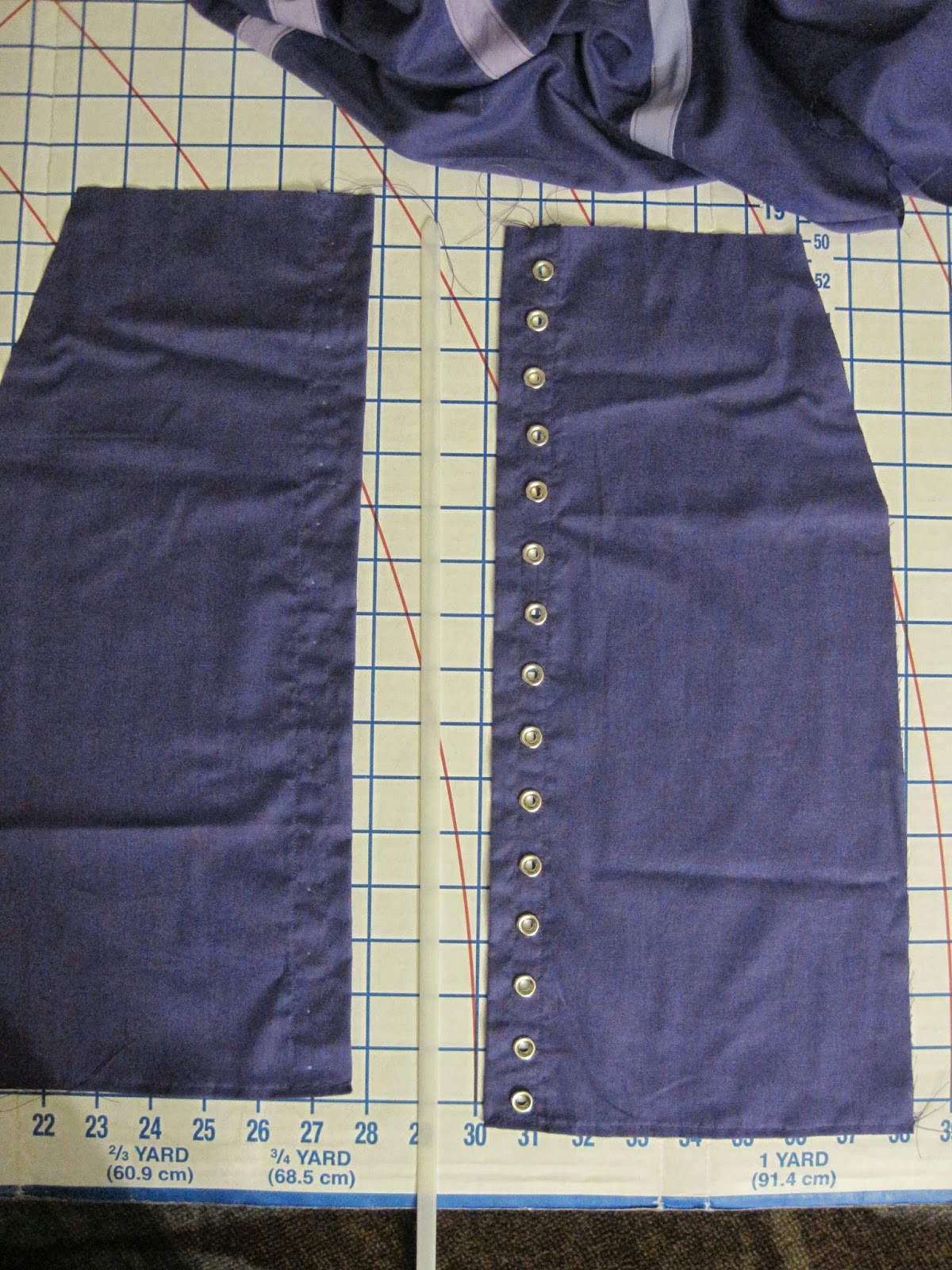
I got a lot done actually in one afternoon, including adapting the inner support panel so that it laces and the bustle will collapse.

Marking the back pieces for the wire channels
Adapted panel pieces
Unfortunately, it was getting late and I ended up thwarted by the fact that I ran out of supplies. To finish, I have to get some more grommets but rather than order just grommets, I might as well take advantage of flat shipping and order some other corset and crinoline/bustle supplies that are on the shopping list as well.